
|
为了赞助大师周全领会2022年天下乙卷高考英语卷,上面咱们为大师清算了最新的2022年天下乙卷高考英语试卷及谜底,大师就能够晓得2022年天下乙卷高考英语难不难?有哪些题型?考了哪些常识点?和高考英语试卷的解题思绪和方式有哪些?但愿对大师有所赞助。 2022年天下乙卷高考英语试卷
注重事变:
1. 答卷前,考生务必将本身的姓名、准考据号填写在答题卡上。 2. 回覆挑选题时,选出每小题谜底后,用铅笔把答题卡上对应标题问题的谜底标号涂黑。如需点窜,用橡皮擦干净后,再选涂其余谜底标号。回覆非挑选题时,将谜底写在答题卡上,写在本试卷上有效。 3. 测验竣事后,将本试卷和答题卡一并交回。 第一局部听力(共两节,满分30分) 做题时,先将谜底标在试卷上。灌音内容竣事后,你将有两分钟的时候将试卷上的谜底转涂到答题卡上。 第一节(共5小题;每小题1.5分,满分7.5分) 听上面5段对话。每段对话后有一个小题,从题中所给的A、B、C三个选项当选出最好选项。听完每段对话后,你都有10秒钟的时候来回覆有关小题和浏览下一小题。每段对话仅读一遍。 例:How much is the shirt? A. £19.15. B. £9.18. C. £9.15. 谜底是C。 1. What does the man want to do? A. Have breakfast. B. Take a walk. C. Call his office. 2. What was George doing last night? A. Having a meeting. B. Flying home. C. Working on a project. 3. Why does the man suggest going to the park? A. It's big. B. It's quiet. C. It's new. 4. How does the woman sound? A. Annoyed. B. Pleased. C. Puzzled. 5. Where is the man's table? A. Near the door. B. By the window. C. In the corner. 第二节(共15小题;每小题1.5分,满分22.5分) 听上面5段对话或独白。每段对话或独白后有几个小题,从题中所给的A、B、C三个选项当选出最好选项。听每段对话或独白前,你将偶然候浏览各个小题,每小题5秒钟;听完后,各小题将给出5秒钟的作答时候。每段对话或独白读两遍。 听第6段资料,回覆第6、7题。 6. What are the speakers going to do tonight? A. Eat out. B. Go shopping. C. Do sports. 7. What is the probable relationship between the speakers? A. Boss and secretary. B. Hostess and guest. C. Husband and wife. 听第7段资料,回覆第8、9题。 8. Why does the woman think July is the best time to move? A. Their business is slow. B. The weather is favorable. C. It's easy to hire people. 9. How will they handle the moving? A. Finish it all at once. B. Have the sales section go first. C. Do one department at a time. 听第8段资料,回覆第10至12题。 10. What did Peter learn from his grandfather? A. How to appreciate art works. B. How to deal with artists. C. How to run a museum. 11. What did Peter do in Chicago? A. He studied at a college. B. He served in the army. C. He worked in a gallery. 12. Whose works did Peter like best? A. Rembrandt's. B. Botticelli's. C. Rubens'. 听第9段资料,回覆第13至16题。 13. Where does the conversation take place? A. At a library. B. In a law firm. C. On a train. 14. By what time did John plan to finish his term paper? A. March. B. August. C. October. 15. Why did John quit his part-time job? A. He had to catch up with his study. B. He was offered a better one. C. He got tired of it. 16. What is Susan's attitude to John's problem? A. Carefree. B. Understanding. C. Forgiving. 听第10段资料,回覆第17至20题。 17. What did the speaker do before the year 2012? A. A fitness coach. B. A chess player. C. A marathon runner. 18. Why was the 2016 Olympics important for the speaker? A. He was motivated by Bolt. B. He broke a world record. C. He won fifth place. 19. Which is the hardest for the speaker? A. Getting over an injury. B. Doing strength training. C. Representing Botswana. 20. What is the speaker mainly talking about? A. His plan to go for the gold. B. His experience on the track. C. His love for his home country. 第二局部 浏览懂得(共两节,满分40分) 第一节(共15小题;每小题2分,满分30分) 浏览以下漫笔,从每题所给的A、B、C和D四个选项中,选出最好选项。 A Henry Raeburn(1756-1823) The Exhibition This exhibition of some sixty masterpieces celebrating the life and work of Scotland's best loved painter, Sir Henry Raeburn, comes to London. Selected from collections throughout the world, it is the first major exhibition of his work to be held in over forty years. Lecture Series Scottish National Portrait(肖像画)Gallery presents a series of lectures for the general public. They are held in the Lecture Room. Admission to lectures is free.
Exhibition Times Monday-Saturday 10.00-17.45 Sunday 12.00-17.45 Last admission to the exhibition: 17.15. There is no re-admission. Closed: 24-26 December and 1 January. Admission £4. Children under 12 years accompanied by an adult are admitted free. Schools and Colleges A special low entrance charge of f2 per person is available to all in full-time education, up to and including those at first degree level, in organised groups with teachers. 21. What is the right time for attending Raeburn's English Contemporaries? A. Sun. 26 Oct. B. Thurs. 30 Oct. C. Thurs. 6 Nov. D. Thurs.13 Nov. 22. How much would a couple with two children under 12 pay for admission? A. £4. B. £8. C. £12. D. £16. 23. How can full-time students get group discounts? A. They should go on Sunday mornings. B. They should come from art schools. C. They must be led by teachers. D. They must have ID cards with them. B In 1916, two girls of wealthy families, best friends from Auburn, N. Y.—Dorothy Woodruff and Rosamond Underwood—traveled to a settlement in the Rocky Mountains to teach in a one-room schoolhouse. The girls had gone to Smith College. They wore expensive clothes. So for them to move to Elkhead, Colo. to instruct the children whose shoes were held together with string was a surprise. Their stay in Elkhead is the subject of Nothing Daunted: The Unexpected Education of Two Society Girls in the West by Dorothy Wickenden, who is a magazine editor and Dorothy Woodruff's granddaughter. Why did they go then? Well, they wanted to do something useful. Soon, however, they realized what they had undertaken. They moved in with a local family, the Harrisons, and, like them, had little privacy, rare baths, and a blanket of snow on their quilt when they woke up in the morning. Some mornings, Rosamond and Dorothy would arrive at the schoolhouse to find the children weeping from the cold. In spring, the snow was replaced by mud over ice. In Wickenden's book, she expanded on the history of the West and also on feminism, which of course influenced the girls' decision to go to Elkhead. A hair-raising section concerns the building of the railroads, which entailed(牵扯)drilling through the Rockies, often in blinding snowstorms. The book ends with Rosamond and Dorothy's return to Auburn. Wickenden is a very good storyteller. The sweep of the land and the stoicism(坚贞)of the people move her to some beautiful writing. Here is a picture of Dorothy Woodruff, on her horse, looking down from a hill top: "When the sun slipped behind the mountains, it shed a rosy glow all around them. Then a full moon rose. The snow was marked only by small animals: foxes, coyotes, mice, and varying hares, which turned white in the winter." 24. Why did Dorothy and Rosamond go to the Rocky Mountains? A. To teach in a school. B. To study American history. C. To write a book. D. To do sightseeing. 25. What can we learn about the girls from paragraph 3? A. They enjoyed much respect. B. They had a room with a bathtub. C. They lived with the local kids. D. They suffered severe hardships. 26. Which part of Wickenden's writing is hair-raising? A. The extreme climate of Auburn. B. The living conditions in Elkhead. C. The railroad building in the Rockies. D. The natural beauty of the West. 27. What is the text? A. A news report. B. A book review. C. A children's story. D. A diary entry. C Can a small group of drones(无人机)guarantee the safety and reliability of railways and, at the same time, help railway operators save billions of euros each year? That is the very likely future of applying today's "eyes in the sky" technology to making sure that the millions of kilometres of rail tracks and infrastructure(根本举措措施)worldwide are safe for trains on a 24/7 basis. Drones are already being used to examine high-tension electrical lines. They could do precisely the same thing to inspect railway lines and other vital aspects of rail infrastructure such as the correct position of railway tracks and switching points. The more regularly they can be inspected, the more railway safety, reliability and on-time performance will be improved. Costs would be cut and operations would be more efficient(高效)across the board. That includes huge savings in maintenance costs and better protection of railway personnel safety. It is calculated that European railways alone spend approximately 20 billion euros a year on maintenance, including sending maintenance staff, often at night, to inspect and repair the rail infrastructure. That can be dangerous work that could be avoided with drones assisting the crews' efforts. By using the latest technologies, drones could also start providing higher-value services for railways, detecting faults in the rail or switches, before they can cause any safety problems. To perform these tasks, drones for rail don't need to be flying overhead. Engineers are now working on a new concept: the rail drones of the future. They will be moving on the track ahead of the train, and programmed to run autonomously. Very small drones with advanced sensors and AI and travelling ahead of the train could guide it like a co-pilot. With their ability to see ahead, they could signal any problem, so that fast-moving trains would be able to react in time. 28. What makes the application of drones to rail lines possible? A. The use of drones in checking on power lines. B. Drones' ability to work at high altitudes. C. The reduction of cost in designing drones. D. Drones' reliable performance in remote areas. 29. What does "maintenance" underlined in paragraph 3 refer to? A. Personnel safety. B. Assistance from drones. C. Inspection and repair. D. Construction of infrastructure. 30. What function is expected of the rail drones? A. To provide early warning. B. To make trains run automatically. C. To earn profits for the crews. D. To accelerate transportation. 31. Which is the most suitable title for the text? A. What Faults Can Be Detected with Drones B. How Production of Drones Can Be Expanded C. What Difficulty Drone Development Will Face D. How Drones Will Change the Future of Railways D The Government's sugar tax on soft drinks has brought in half as much money as Ministers first predicted it would generate, the first official data on the policy has shown. First announced in April, 2016, the tax which applies to soft drinks containing more than 5g of sugar per 100ml, was introduced to help reduce childhood obesity(瘦削). It is believed that today's children and teenagers are consuming three times the recommended level of sugar, putting them at a higher risk of the disease. Initially the sugar tax was expected to make £520m a year for the Treasury. However, data of the first six months showed it would make less than half this amount. At present it is expected to generate £240m for the year ending in April 2019, which will go to school sports. It comes after more than half of soft drinks sold in shops have had their sugar levels cut by manufacturers(制作商)so they can avoid paying the tax. Drinks now contain 45 million fewer kilos of sugar as a result of manufacturers' efforts to avoid the charge, according to Treasury figures. Since April drinks companies have been forced to pay between 18p and 24p for every litre of sugary drink they produce or import, depending on the sugar content. However, some high sugar brands, like Classic Coca Cola, have accepted the sugar tax and are refusing to change for fear of upsetting consumers. Fruit juices, milk-based drinks and most alcoholic drinks are free of the tax, as are small companies manufacturing fewer than 1m litres per year. Today's figures, according to one government official, show the positive influence the sugar tax is having by raising millions of pounds for sports facilities(举措措施)and healthier eating in schools. Helping the next generation to have a healthy and active childhood is of great importance, and the industry is playing its part. 32. Why was the sugar tax introduced? A. To collect money for schools. B. To improve the quality of drinks. C. To protect children's health. D. To encourage research in education. 33. How did some drinks companies respond to the sugar tax? A. They turned to overseas markets. B. They raised the prices of their products. C. They cut down on their production. D. They reduced their products' sugar content. 34. From which of the following is the sugar tax collected? A. Most alcoholic drinks. B. Milk-based drinks. C. Fruit juices. D. Classic Coke. 35. What can be inferred about the adoption of the sugar tax policy? A. It is a short-sighted decision. B. It is a success story. C. It benefits manufacturers. D. It upsets customers. 第二节(共5小题;每小题2分,满分10分) 根据漫笔内容,从漫笔后的选项当选出能填入空缺处的最好选项。选项中有两项为过剩选项。 Friendship needs care and attention to keep it in good health. Here are five ways to sustain(坚持)long-distance friendships. ·Set a regular date Long-lasting friendships share the characteristic that both sides equally contact(接洽)and share with one another. With busy schedules, squeezing in phone calls can be a challenge. 36 ·More isn't always merrier Make sure you have communicated with your friend about how frequently each of you wants to be contacted and what method works best for you both. 37 . There are alternatives to constant written communication, such as leaving voice messages or having a group chat. ·Practise empathy(共情) 38 . The friend who is remaining needs to be sensitive to all the additional time demands placed on the friend who has moved. The one in the new environment should be sympathetic to the fact that your friend may feel abandoned. · 39 Anniversaries and birthdays carry even more weight in long-distance friendships. Although technology might make day-to-day communication possible, extra effort goes a long way on special days. Simply keeping a diary that keeps track of friends' birthdays and other important dates will make sure nothing slips by you. ·Don't rely on technology alone 40 , but long-distance friendships -even close ones -may require more conscious effort to sustain. Try to seek out chances to renew friendships. How to do it? Just spend face-to-face time together whenever possible. A. Remember important dates B. Compensate by writing letters C. It is also helpful for you to be a friendship keeper D. Try to find a time that works for both of you and stick to it E. Friends need to talk about their preferred methods of communication F. It is easy to have a sense of connectedness through social media G. You may be the friend who left or the one who was left behind 说话常识应用(共两节,满分45分) 第一节(共20小题;每小题1.5分,满分30分) 浏览上面漫笔,从漫笔后各题所给的A、B、C和D四个选项中,选出能够填入空缺处的最好选项。 Young children across the globe enjoy playing games of hide and seek. For them, there's something highly exciting about 41 someone else's glance and making oneself unable to be seen. However, we all witness that preschool children are remarkably 42 at hiding. They often cover only their eyes with their hands, leaving the rest of their bodies 43 . For a long time, this ineffective hiding method was 44 as evidence that children are hopelessly "egocentric"(自我中间的)creatures. But our 45 research results in child developmental psychology 46 that idea. We brought young children aged 2-4 into our Minds in Development Lab at USC. Each 47 sat down with an adult who covered her own eyes or 48 . We then asked the child if she could 49 or hear the adult. Surprisingly, children replied that they couldn't. The same 50 happened when the adult covered her own mouth: 51 children said that they couldn't 52 to her. A number of 53 ruled out that the children misunderstood what they were being asked. The results were clear: Our young subjects 54 the questions and knew 55 what was asked of them. Their 56 to the questions reflected their true 57 that "I can see you only if you can see me, too." They simply 58 mutual(彼此的)recognition and regard. Our 59 suggest when a child "hides" by putting a blanket over her head, it is not a result of egocentrism. In fact, children consider this method 60 when others use it. 41. A. following B. taking C. escaping D. directing 42. A. clever B. bad C. scared D. quick 43. A. exposed B. examined C. untouched D. imbalanced 44. A. supported B. guaranteed C. imagined D. interpreted 45. A. disappointing B. mixed C. surprising D. desired 46. A. explained B. confirmed C. contradicted D. tested 47. A. parent B. child C. researcher D. doctor 48. A. feet B. nose C. hands D. ears 49. A. see B. help C. reach D. fool 50. A. event B. thing C. action D. accident 51. A. Yet B. Now C. Soon D. Once 52. A. speak B. listen C. tum D. wave 53. A. instructions B. descriptions C. experiments D. assumptions 54. A. comprehended B. predicted C. explored D. ignored 55. A. partly B. honestly C. vaguely D. exactly 56. A. responses B. approaches C. contribution D. sensitivity 57. A. ability B. belief C. identity D. purpose 58. A. hold back B. relate to C. insist on D. make up 59. A. limitations B. requirements C. theories D. findings 60. A. tentative B. impressive C. creative D. effective 第二节(共10小题;每小题1.5分,满分15分) 浏览上面漫笔,在空缺处填入1个恰当的单词或括号内单词的准确情势。 May 21st this year marks the first International Tea Day, which was named officially 61 the United Nations on November 27th, 2019. To celebrate 62 festival, a number of events took place at the Chinese Businessman Museum in Beijing on Thursday. The chairman of the China Culture Promotion Society 63 (address)the opening ceremony. "As a main promoter of the International Tea Day, the birthplace of tea and the 64 (large)tea-producing country, China has a 65 (responsible)to work with other countries to promote the healthy development of the tea industry. It can help to build a community with a 66 (share)future for mankind," he said. The "First International Tea Day Tea Road Cooperative Initiative" issued(宣布)at the ceremony calls for people working in the tea industry to come together to promote international cooperation 67 cultural exchanges. A four-year tea promotion—Tea Road Cooperative Plan—was also issued in accordance with the initiative. 68 (strengthen)the connection with young people, the event included a number of public promotional activities on social media, 69 (invite)twenty-nine tea professionals from around the world to have thirty-six hours of uninterrupted live broadcasts. The Chinese Ancient Tea Museum was officially unveiled(开幕)at the ceremony, opening 70 (it)first exhibition: The Avenue of Truth—A Special Exhibition of Pu'er Tea. 第四局部 写作(共两节,满分35分) 第一节,漫笔改错(共10小题;每小题1分,满分10分) 假设英语课上教员请求同桌之间互换点窜作文,请你点窜你同桌写的以下作文。文中共有10处说话毛病,每句中最多有两处。每处毛病仅触及一个单词的增添、删除或点窜 增添:在缺词处加一个漏字符号(^),并在其上面写出该加的词。 删除:把过剩的词用斜线()划掉。 点窜:在错的词下齐截横线,并在该词上面写出点窜后的词。 注重:1.每处毛病及其点窜均仅限一词; 2.只许可点窜10处,多者(从第11处起)不计分。 We all know that cycling is a greatly exercise. A doctor tells me people who lives the longest are dancers and cyclists. Maybe it is because the combination of fresh air, smooth movement and exercise. Whether you ride a bicycle, you don't use petrol. So they are not producing carbon dioxide and not cause air pollution. Just see how cars have been taken over our cities. They often run at high speeds, what may put our lives in danger. And there were traffic jams, too. Our cities will be better places if we replace cars with bicycle. 第二节 书面抒发(满分25分) 黉舍英文报正在展开以Learning English Beyond the Classroom为题的会商。请利用图表中的查问拜访成果写一篇漫笔投稿,内容包含: 1.进修勾当状态描写: 2.简略批评; 3.你的倡议。 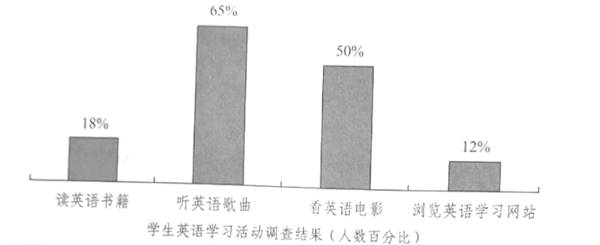 注重: 1.词数100摆布; 2.漫笔的标题问题和首句已为你写好。 2022年天下乙卷高考英语谜底剖析 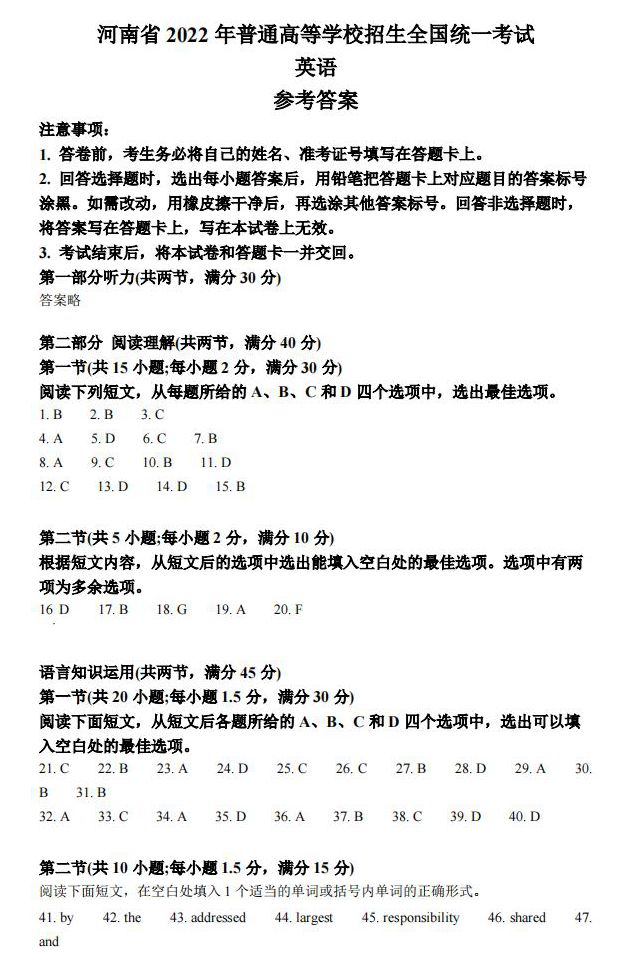 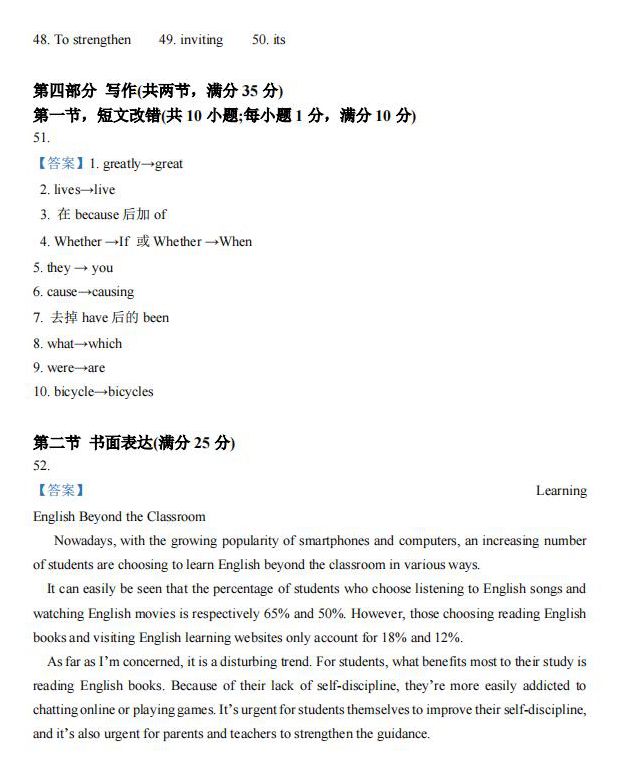 2022年天下乙卷高考英语试卷及谜底就为大师先容到这里,但愿大师存眷高考栏目,咱们为大师供给2022年全套高测验卷及谜底的同时,也为大师供给了高考绩绩查问时候及进口、高考自愿填报时候及进口、高考分数线、高考登科查问时候等外容但愿对大师有所赞助。 与2022年高考有关的其余文章: 2022年高考真题及谜底剖析(完全版) 2022年高考绩绩查问时候及进口 2022年高考自愿填报进口 2022年各地高考分数线一览表 本年高考考生几多人? |
热点搜刮:高考时候 高考分数线 一分一段表